

When “In the Beginning” Wasn’t the Beginning You Thought It Was
For generations, we’ve begun our journey into Genesis with those familiar words: “In the beginning, God created the heavens and the earth.” It’s a foundational truth, etched into our understanding of God as the ultimate Creator. But what if those powerful verses, Genesis 1:1-2, aren’t part of the seven days of creation? What if they’re painting a picture of something else entirely—a world that was created at some time in the past, Genesis 1:1, and now in Genesis 1:2 exists already in a state of primordial chaos, awaiting God’s grand re-ordering?
This isn’t about dismantling cherished beliefs, but about deepening our understanding of God’s Word. Drawing on the insights of scholars like Dr. Michael Heiser, we’re challenged to look closer at the original Hebrew, and what we find might just revolutionize our view of creation.
The Hebrew Hints: Creation From Chaos, Not From Nothing
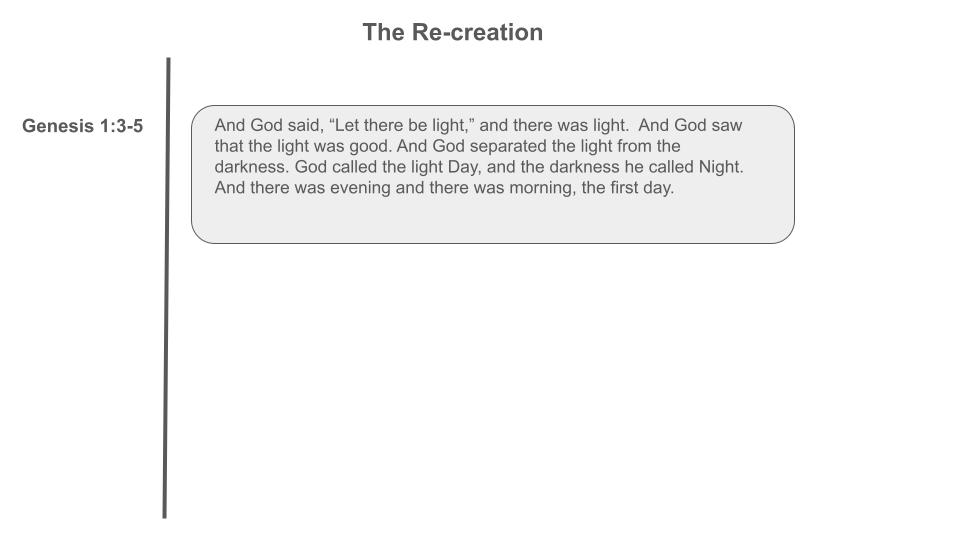
Dr. Heiser’s compelling argument points to a subtle yet significant nuance in the Hebrew of Genesis 1:1-2. Instead of the traditional “In the beginning God created…”, a more accurate rendering could be “When God began to create…” This seemingly small shift carries immense weight, suggesting that the true commencement of God’s direct creative work in Genesis begins not in verse 1, but in verse 3: “Let there be light.” According to Heiser, Genesis 1:1-2 are dependent clauses of Genesis 1:3. They set context for verse 1:3 which starts the creation account.
If Genesis 1:2 describes a pre-existing state of chaos—a “formless and empty” deep—then God’s creative act in the rest of Genesis isn’t ex nihilo (from nothing) but ex chao (from chaos). He’s not bringing something from absolute non-existence, but rather magnificently ordering and shaping what’s already there.
This “creation from chaos” perspective isn’t just an isolated academic idea. It finds support from other respected scholars like Bruce Waltke and even resonates with passages like 2 Peter 3:4-5. It also prompts a crucial question: Could the widely accepted doctrine of creation ex nihilo as part of the seven days of creation have developed later in Christian thought, perhaps as a response to early heresies? This deeper look compels us to prioritize sound biblical exegesis above all else, even over long-held assumptions.
Echoes of an Earlier Creation and a Recurring Pattern
This fresh look at Genesis opens the door to another profound question: If Genesis 1 describes a re-creation, was there an original creation that came before it? The Bible, surprisingly, drops hints of just such an event, revealing a recurring pattern of creation, fall, and judgment that stretches beyond just humanity.
Consider these biblical clues:
- Isaiah 45:18 describes God creating the earth “to be inhabited,” not “formless and void.” This starkly contrasts with Genesis 1:2, hinting at a prior, perfect creation that was somehow disrupted.
- Nehemiah 9:6 speaks of God creating the heavens, the “host of heaven” (angelic beings), and the earth. This suggests an original creation event that included the angelic realm.
- Job 38:4-7 paints a vivid picture of God laying the earth’s foundations while the “morning stars” (angels) rejoiced. Their jubilation implies they were the initial inhabitants of this pristine creation.
- Even the New Testament reinforces this idea, with passages like Acts 17:24 and Romans 8:20-22 pointing to a fundamental creation from nothing, implying an original event preceding the Genesis seven days account.
The Pattern of Fall and Judgment
The Bible consistently reveals a cycle of creation, fall, and judgment. We see it clearly with Adam and Eve in Eden, where their idyllic existence is shattered by sin, leading to expulsion and judgment. But this pattern isn’t exclusive to humanity; it began in the angelic realm:
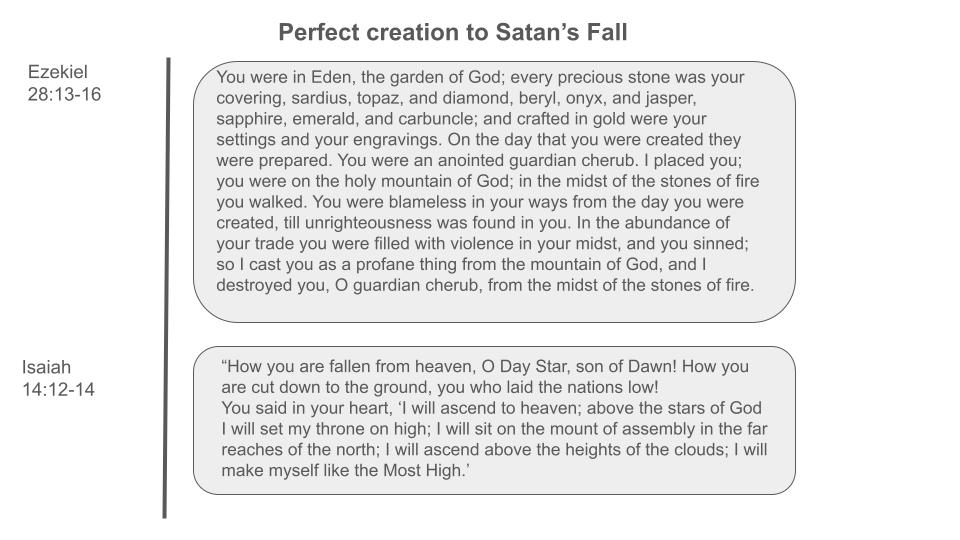
- Satan’s Fall: Ezekiel 28:12-19 offers a glimpse into Satan’s magnificent pre-fall state—a being of beauty and wisdom in the “Garden of Eden”—before pride led to his rebellion and expulsion. This mirrors humanity’s story, showing that free will, given by God to both angels and humans, carries the potential for devastating consequences.
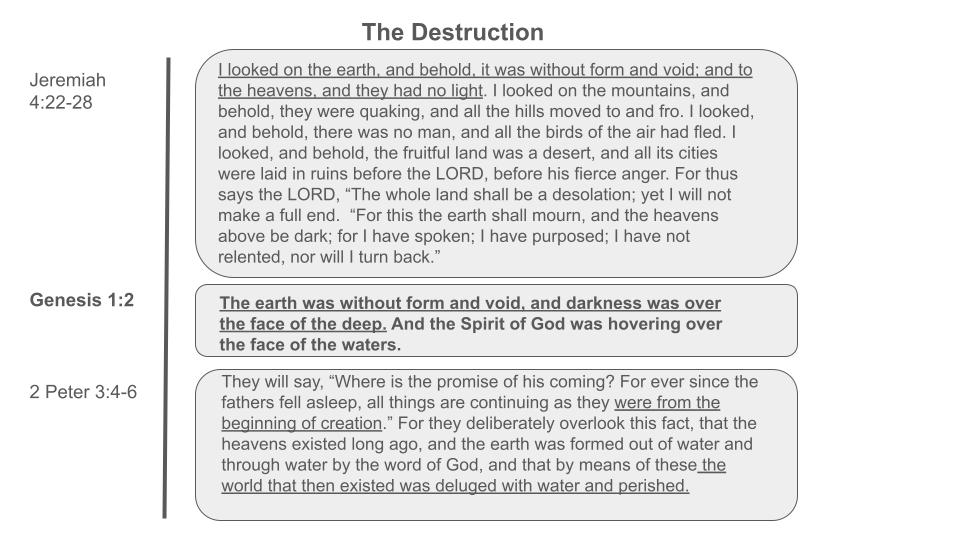
If there was an original creation inhabited by angels, what caused the chaotic state described in Genesis 1:2? Jeremiah 4:22-28 provides a chilling possibility. It depicts a devastating judgment upon the earth, leaving it “formless, void, and dark”—eerily similar to Genesis 1:2. This powerful passage suggests that Genesis 1 might not be describing the initial creation, but rather a re-creation that followed a massive, prior judgment.
Let’s look closely at 2 Peter 3:4-6:
- 2 Peter 3:4-5: “by saying, ‘What happened to the Messiah’s promise to return? Ever since our ancestors died, everything continues as it did from the beginning of creation.’ But they deliberately ignore the fact that long ago the heavens existed and the earth was formed by God’s word out of water and with water,”
- 2 Peter 3:6: “by which the world at that time was deluged with water and destroyed.”
Notice how Peter references an existing heaven and an earth “formed by God’s word out of water and with water.” Then, verse 6 describes how this world was “deluged with water and destroyed.” Could Peter be pointing to an earlier, pre-Adamic judgment that left the earth in the chaotic state of Genesis 1:2, which God then re-ordered?
This aligns perfectly with the recurring biblical pattern:
Angelic Realm:
- Creation: Job 38
- Idyllic Existence: Ezekiel 28
- Sin Enters: Ezekiel 28:15-16
- Sin Corrupts: Ezekiel 28 (implied) and Jeremiah 4 (cities mentioned, suggesting pre-human habitation)
- Massive Judgment: Jeremiah 4:23-26, 2 Peter 3:6 (leading to the Genesis 1:2 chaotic state)
Humanity:
- Creation (Re-creation): Genesis 1
- Idyllic Existence: Genesis 2
- Sin Enters: Genesis 3
- Sin Corrupts: Genesis 6
- Massive Judgment: Genesis 6-9 (Noah’s Flood)
A Look at the Possible Order of Events

A Deeper Understanding of God’s Story
This exploration isn’t about dismissing Genesis 1, but enriching it. It challenges us to consider that it might be a beautiful account of re-creation after a prior judgment. This framework offers a fresh, cohesive perspective on the biblical narrative, highlighting a profound and recurring pattern of creation, fall, and judgment that applies to both angelic beings and humanity.
It invites us to move beyond superficial readings, encouraging a deeper engagement with the Genesis text and the broader context of Scripture. Ultimately, it strengthens our understanding of God’s incredible power, His justice, and His unfailing redemptive purposes throughout history.
 Biblical Logos Blog
Leave a comment