
A friend of mine started going to a new church after he moved. He and his family love the church. Soon after, his old pastor checked up on him and asked him about his new church. At that point, the old pastor expressed some concerns about this new church they were attending. One of the concerns was over the doctrine of the Baptism of of the Holy Spirit. His new church pointed to Acts 19:1-7 in their doctrinal statement. They said there is a second work of receiving the Baptism of the Holy Spirit after you believe. This is a common Pentecostal doctrine which is secondary to core doctrines like Salvation. In this post, we will look at an historical way of viewing this situation in Acts 19.
Let’s look at this passage in question first:
Act 19:1 And it happened that while Apollos was at Corinth, Paul passed through the inland country and came to Ephesus. There he found some disciples.
Act 19:2 And he said to them, “Did you receive the Holy Spirit when you believed?” And they said, “No, we have not even heard that there is a Holy Spirit.”
Act 19:3 And he said, “Into what then were you baptized?” They said, “Into John’s baptism.”
Act 19:4 And Paul said, “John baptized with the baptism of repentance, telling the people to believe in the one who was to come after him, that is, Jesus.”
Act 19:5 On hearing this, they were baptized in the name of the Lord Jesus.
Act 19:6 And when Paul had laid his hands on them, the Holy Spirit came on them, and they began speaking in tongues and prophesying.
Act 19:7 There were about twelve men in all.
If you check commentaries, there is a debate about the phrasing in Verse 19:2. Some say the quote should read “Did you receive the Holy Spirit since you believed?”. It questions if the Holy Spirit comes at the point of Salvation or after it. Let’s take a more historical look at what happened here:
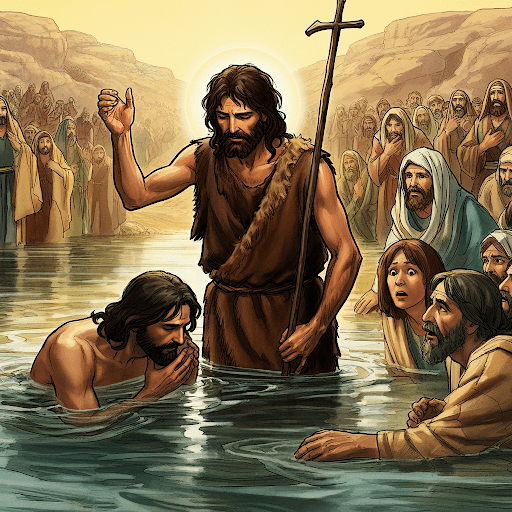
Verse 19:3 says these men had been baptized into “John’s Baptism”. John’s baptism was a baptism of repentance:
Mat 3:1 In those days John the Baptist came preaching in the wilderness of Judea,
Mat 3:2 “Repent, for the kingdom of heaven is at hand.”
Mat 3:3 For this is he who was spoken of by the prophet Isaiah when he said, “The voice of one crying in the wilderness: ‘Prepare the way of the Lord; make his paths straight.’”
Mat 3:4 Now John wore a garment of camel’s hair and a leather belt around his waist, and his food was locusts and wild honey.
Mat 3:5 Then Jerusalem and all Judea and all the region about the Jordan were going out to him,
Mat 3:6 and they were baptized by him in the river Jordan, confessing their sins.
Mat 3:7 But when he saw many of the Pharisees and Sadducees coming to his baptism, he said to them, “You brood of vipers! Who warned you to flee from the wrath to come?
Mat 3:8 Bear fruit in keeping with repentance.
Mat 3:9 And do not presume to say to yourselves, ‘We have Abraham as our father,’ for I tell you, God is able from these stones to raise up children for Abraham.
Mat 3:10 Even now the axe is laid to the root of the trees. Every tree therefore that does not bear good fruit is cut down and thrown into the fire.
Mat 3:11 “I baptize you with water for repentance, but he who is coming after me is mightier than I, whose sandals I am not worthy to carry. He will baptize you with the Holy Spirit and fire.
Mat 3:12 His winnowing fork is in his hand, and he will clear his threshing floor and gather his wheat into the barn, but the chaff he will burn with unquenchable fire.”
John was baptizing Jewish people. He prepared them for the coming Kingdom, which was promised in the OT to the Jewish people. Isaiah then includes the Gentiles as well in the coming Kingdom (Isa 49:6). John was doing this to prepare the way for the coming Messiah.
Before the Kingdom can manifest on Earth, with the Messiah on the throne, there will be a judgment of the Jewish people and then of the Gentiles (Ezekiel 20:33-44, Matthew 25:31-46). The preaching of John The Baptist and even Jesus early ministry (Matthew 4:17) was in preparation for this judgment. This judgment is also modeled in the Jewish Feasts of Trumpets, Day of Atonement and Tabernacles.
This coming Kingdom promise was then postponed when Jesus was rejected (Luke 19:41-42).
Luk 19:41 And when he drew near and saw the city, he wept over it,
Luk 19:42 saying, “Would that you, even you, had known on this day the things that make for peace! But now they are hidden from your eyes.
In fact, the Holy Spirit could not even come until the Messiah, Jesus had died and rose again:
Joh 16:7 Nevertheless, I tell you the truth: it is to your advantage that I go away, for if I do not go away, the Helper will not come to you. But if I go, I will send him to you.
Joh 16:8 And when he comes, he will convict the world concerning sin and righteousness and judgment:
Joh 16:9 concerning sin, because they do not believe in me;
Joh 16:10 concerning righteousness, because I go to the Father, and you will see me no longer;
Joh 16:11 concerning judgment, because the ruler of this world is judged.
Joh 16:12 “I still have many things to say to you, but you cannot bear them now.
Joh 16:13 When the Spirit of truth comes, he will guide you into all the truth, for he will not speak on his own authority, but whatever he hears he will speak, and he will declare to you the things that are to come.
Joh 16:14 He will glorify me, for he will take what is mine and declare it to you.
Joh 16:15 All that the Father has is mine; therefore I said that he will take what is mine and declare it to you.
So the Holy Spirit did not come until Jesus died, was buried and rose again. He went to the Father and then the Holy Spirit came. If you look at Matthew 3:11 above, John the Baptist even said that his baptism was just with water… not the Holy Spirit. What was the situation when Paul met the 12 men? This event occurred during his journey through Ephesus as described in Acts 19:1-7.
First John the Baptist was baptizing people with the water baptism of repentance as was Jesus and his disciples. They did this in preparation for the promised ‘Kingdom’ of the OT. Can you imagine it? John was preaching and baptizing so many people, even ‘the Pharisees and Sadducees (Matt 3:7)’ came to see what John the Baptist was saying and doing. Thousands of people were probably baptized with this water baptism of repentance. This happened during the life of John and the early baptizing of Jesus’ disciples. Now in Acts 19, we see Paul on one of his missionary journeys. He enters Ephesus and encounters a group of men. They had not yet heard of the gift of the Holy Spirit. This gift accompanies the Gospel of Grace (1 Corinthians 15:1-11).
Thousands of people from the time of John the Baptist’s preaching (~ AD 28 to 29) would have been in this condition of knowing only John’s baptism of repentance. This continued until Paul entered Ephesus in AD 52. These men did not yet know the Gospel of Grace, which is the scene depicted in Acts 19:1-7.
Context is the most important interpretation rule for any reader in the Bible. Our passage in Acts 19:1-7 is immediately proceeded by Acts 18:24-28.
Act 18:24 Now a Jew named Apollos, a native of Alexandria, came to Ephesus. He was an eloquent man, competent in the Scriptures.
Act 18:25 He had been instructed in the way of the Lord. And being fervent in spirit, he spoke and taught accurately the things concerning Jesus, though he knew only the baptism of John.
Act 18:26 He began to speak boldly in the synagogue, but when Priscilla and Aquila heard him, they took him aside and explained to him the way of God more accurately.
Act 18:27 And when he wished to cross to Achaia, the brothers encouraged him and wrote to the disciples to welcome him. When he arrived, he greatly helped those who through grace had believed,
Act 18:28 for he powerfully refuted the Jews in public, showing by the Scriptures that the Christ was Jesus.
Just before our Acts 19 passage, we observe Apollos preaching. He is teaching about the “way of the Lord” concerning Jesus. However, he only knew of the baptism of John. Notice he was fervent in spirit (small “s”). He was passionate that Jesus is the Messiah. Yet, he only knew of John’s baptism. Priscilla and Aquila had to explain the way of God more accurately to him. After which, when Apollos went to Achaia “he greatly helped those who through grace had believed” (Acts 18:27). These passages confirm the situation in the day of Paul’s missionary journeys. Paul encountered many people familiar with John the Baptist’s message, however, they were unaware of the Gospel of Grace. This Gospel brings the Holy Spirit!
Conclusion: Acts 19:1-7 is a historical account of what the Apostle Paul encountered on his missionary journeys. Many people had listened to the teachings of John the Baptist. They had been baptized into repentance for the coming Kingdom. This was also taught by Jesus and his disciples. After the Jewish people formally rejected Jesus, the Kingdom’s offer promised in the OT was set aside. Jesus was then crucified and rose again, defeating death. This opened the way for the New Covenant and the Gospel of Grace to go forward. It was only after Jesus’ death and resurrection that the Holy Spirit indwelling was given to believers. Now 20-25 years after the death of Jesus we have the situation in Acts 18:24-28 and Acts 19:1-7. People who had not yet heard the Gospel of Grace, but had only heard and been baptized into “John’s Baptism.” This is no longer an issue in the Church. We have the full counsel of God’s Word. It highlights the finished work on the cross and the Gospel of Grace. In this, we all receive the Baptism of the Spirit (1 Corinthians 12:13).

 Biblical Logos Blog
Leave a comment