
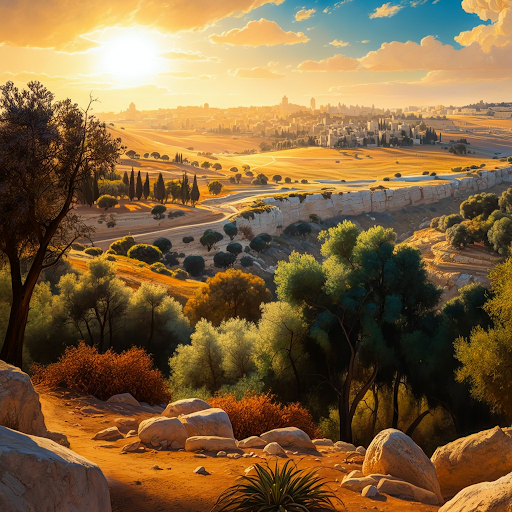
Where did Jesus go between the time of his crucifixion and his resurrection three days later? That question apparently has been in hot debate since the second and third century. The question speaks to the broader question of what happens when we die and what is heaven like. In this post, we will look at several scriptures and writings from early Church fathers. Along the way, it seems the central issue may actually be: Where is Paradise?
The Paradox
Let’s begin with a possible Biblical paradox. Jesus when he was being crucified said to the repentant thief next to him on the cross:
Luk 23:42 -43 And he said, “Jesus, remember me when you come into your kingdom.” And he said to him, “Truly, I say to you, today you will be with me in paradise.”
Jesus proclaims that he and the repentant thief will be in “paradise” on that day. They will be there when they die. Now we also have Jesus narrative on Hades / the Pit or Hell. He describes two different places where people go when they die.
Luk 16:19 – 31 “There was a rich man who was clothed in purple and fine linen and who feasted sumptuously every day. And at his gate was laid a poor man named Lazarus, covered with sores, who desired to be fed with what fell from the rich man’s table. Moreover, even the dogs came and licked his sores. The poor man died and was carried by the angels to Abraham’s side. The rich man also died and was buried, and in Hades, being in torment, he lifted up his eyes and saw Abraham far off and Lazarus at his side. And he called out, ‘Father Abraham, have mercy on me, and send Lazarus to dip the end of his finger in water and cool my tongue, for I am in anguish in this flame.’ But Abraham said, ‘Child, remember that you in your lifetime received your good things, and Lazarus in like manner bad things; but now he is comforted here, and you are in anguish. And besides all this, between us and you a great chasm has been fixed, in order that those who would pass from here to you may not be able, and none may cross from there to us.’ And he said, ‘Then I beg you, father, to send him to my father’s house— for I have five brothers—so that he may warn them, lest they also come into this place of torment.’ But Abraham said, ‘They have Moses and the Prophets; let them hear them.’ And he said, ‘No, father Abraham, but if someone goes to them from the dead, they will repent.’ He said to him, ‘If they do not hear Moses and the Prophets, neither will they be convinced if someone should rise from the dead.’”
In the Luke 16 passage above, some say it is a parable. Others, however, say it is an actual retelling of a historical event. I lean to the later interpretation. Lazarus is named, and details are given about the dogs licking the sores. It appears as an historical event. Either way, Jesus seems to be telling us there are two abodes of the dead. One of torment and one of comfort. Hades or Hell and Abraham’s Bosom. Abraham’s Bosom is another expression for paradise according to the Early Church fathers the Jewish Encyclopedia.
Hippolytus of Rome, Against Plato, on the Cause of the Universe, §1.
As to the state of the righteous, he writes, “And there the righteous from the beginning dwell, not ruled by necessity, but enjoying always the contemplation of the blessings which are in their view, and delighting themselves with the expectation of others ever new, and deeming those ever better than these. And that place brings no toils to them. There, there is neither fierce heat, nor cold, nor thorn; but the face of the fathers and the righteous is seen to be always smiling, as they wait for the rest and eternal revival in heaven which succeed this location. And we call it by the name Abraham’s bosom.” Ibid.
This also from the Jewish Encyclopedia:
In the New Testament and in Jewish writings a term signifying the abode of bliss in the other world. According to IV Macc. xiii. 17, the righteous who die for their faith are received by Abraham, Isaac, and Jacob in paradise
In the Hellenistic Testament of Abraham…. and finally he asked Abraham to send Lazarus to his father’s house to admonish his five brothers to lead lives characterized by repentance, in order not to meet the same fate as his own. Whereupon Abraham said: “They have the law of Moses and the teachings of the prophets; let them be mindful of these, and they will enter paradise as well as Lazarus.” On Lazarus (Eliezer) and Abraham see Geiger’s “Jüdische Zeitschrift für Wissenschaft und Leben,” vii. 200. It is plain that Abraham is here viewed as the warden of paradise, like Michael in Jewish and St. Peter in Christian folk-lore (“Texts and Studies,” v. 55, 69, Cambridge). Of Abraham as attorney pleading for Israel, R. Jonathan also speaks (Shab. 89b). K.
Lastly, let’s consider some passages that state that this paradise cannot be with the Father in Heaven:
Joh 20:16-17 Jesus said to her, “Mary.” She turned and said to him in Aramaic, “Rabboni!” (which means Teacher). Jesus said to her, “Do not cling to me, for I have not yet ascended to the Father; but go to my brothers and say to them, ‘I am ascending to my Father and your Father, to my God and your God.’”
Joh 14:6 Jesus said to him, “I am the way, and the truth, and the life. No one comes to the Father except through me.
Joh 14:7 If you had known me, you would have known my Father also. From now on you do know him and have seen him.”
In the Gospel of John, Jesus at his resurrection appears first to Mary (Magdalene). Here we see that Jesus says he has “not yet ascended to the Father”. This implies, he has stayed somewhere on or under the Earth. We also have the statements in John 14 saying that “no one comes to the Father except through me”. I believe this invalidates a simple notion that the Old Testament saints just went to “Heaven” when they died. They obviously needed Jesus redemption to ascend to Heaven! So we are left in a bind of sorts. Jesus went to paradise with the thief on the cross next to him. However, that paradise could not be in “Heaven.” Jesus said he had not yet ascended when he saw Mary at his resurrection.
Another Possibility
Can it be that we have three locations in view when talking about spiritual realms? We have a place of torment called Hades or Hell. We also have a place called paradise or Abraham’s Bosom. Finally, we have the Father’s throne and Heaven. This concept was validated by Ireneaus:
Against Heresies (Book V, Chapter 36)
Men shall be actually raised: the world shall not be annihilated; but there shall be various mansions for the saints, according to the rank allotted to each individual. All things shall be subject to God the Father, and so shall He be all in all.
- … Isaiah 66:22 And as the presbyters say, Then those who are deemed worthy of an abode in heaven shall go there, others shall enjoy the delights of paradise, and others shall possess the splendour of the city; for everywhere the Saviour shall be seen according as they who see Him shall be worthy.
- [They say, moreover], that there is this distinction between the habitation of those who produce an hundred-fold, and that of those who produce sixty-fold, and that of those who produce thirty-fold: for the first will be taken up into the heavens, the second will dwell in paradise, the last will inhabit the city; and that was on this account the Lord declared, In My Father’s house are many mansions. John 14:2 For all things belong to God, who supplies all with a suitable dwelling-place; even as His Word says, that a share is allotted to all by the Father, according as each person is or shall be worthy…..
Ireneaus had a unique advantage as he was a direct disciple of Polycarp in the second century A.D. Polycarp himself taught with and eventually took over the Church from the Apostle John in Ephesus. The Apostle John had a vision of Heaven from God which he records in the Book of Revelation. I value his perspective greatly. It was given soon after John received the Book of Revelation, which describes Heaven. Ireneaus more than other Church fathers, like Augustine had a more direct relationship with the Apostle John who received the largest set of scriptures on Heaven. Other Church fathers who wrote on this topic like Augustine were influenced by their predecessor Origen. Origen derived his concepts from “spiritualizing” scripture with influences before him from Plato.
Where is Paradise Then?
Let’s start at the beginning
Gen 2:9 And out of the ground the LORD God made to spring up every tree that is pleasant to the sight and good for food. The tree of life was in the midst of the garden, and the tree of the knowledge of good and evil.
Gen 3:17 And to Adam he said, “Because you have listened to the voice of your wife and have eaten of the tree of which I commanded you, ‘You shall not eat of it,’ cursed is the ground because of you; in pain you shall eat of it all the days of your life;
Gen 3:22-24 Then the LORD God said, “Behold, the man has become like one of us in knowing good and evil. Now, lest he reach out his hand and take also of the tree of life and eat, and live forever—” therefore the LORD God sent him out from the garden of Eden to work the ground from which he was taken. He drove out the man, and at the east of the garden of Eden he placed the cherubim and a flaming sword that turned every way to guard the way to the tree of life.
According to the Encyclopedia Britannica and sources from Wikipedia, the Garden of Eden aka. The Garden of God referenced in Genesis and Ezekiel 28, 31 was “paradise” or the paradise on Earth. We know from the Genesis story that Adam and Eve were driven out of the Garden. A cherubim then guarded it to prevent them from eating of The Tree of Life.
So paradise started as an Earthly place in the region of Mesopotamia. After The Fall, it was hidden, but no mention was made that it went anywhere. At the end of the Bible we find it somewhere else!
Rev 2:7 He who has an ear, let him hear what the Spirit says to the churches. To the one who conquers I will grant to eat of the tree of life, which is in the paradise of God.’
Here we see the promise to the Church in The Book of Revelation. The paradise of God, which has the Tree of Life (same as Genesis account), will become food for us in the time of The Kingdom. Further, Revelation 21 + 22 give us more details as to where paradise is by the end of the Biblical account:
Rev 21:2 And I saw the holy city, new Jerusalem, coming down out of heaven from God, prepared as a bride adorned for her husband.
Rev 21:10 And he carried me away in the Spirit to a great, high mountain, and showed me the holy city Jerusalem coming down out of heaven from God,
Rev 22:1-3 Then the angel showed me the river of the water of life, bright as crystal, flowing from the throne of God and of the Lamb through the middle of the street of the city; also, on either side of the river, the tree of life with its twelve kinds of fruit, yielding its fruit each month. The leaves of the tree were for the healing of the nations. No longer will there be anything accursed, but the throne of God and of the Lamb will be in it, and his servants will worship him.
Rev 22:14 Blessed are those who wash their robes, so that they may have the right to the tree of life and that they may enter the city by the gates.
If we combine all these passages, it seems that paradise was lifted to the realm of Heaven. The Garden of God is now part of New Jerusalem. It will descend at Christ’s second coming depicted in The Book of Revelation.
When did paradise move?
There are several passages that are quoted when we are looking to resolve the fate of the OT saints before the resurrection of Jesus:
Eph 4:7-12 But grace was given to each one of us according to the measure of Christ’s gift. Therefore it says, “When he ascended on high he led a host of captives, and he gave gifts to men.” (In saying, “He ascended,” what does it mean but that he had also descended into the lower regions, the earth? He who descended is the one who also ascended far above all the heavens, that he might fill all things.) And he gave the apostles, the prophets, the evangelists, the shepherds and teachers, to equip the saints for the work of ministry, for building up the body of Christ,
Psa 68:18 You ascended on high, leading a host of captives in your train and receiving gifts among men, even among the rebellious, that the LORD God may dwell there.
Mat 27:51 And behold, the curtain of the temple was torn in two, from top to bottom. And the earth shook, and the rocks were split.
Mat 27:52 The tombs also were opened. And many bodies of the saints who had fallen asleep were raised,
Mat 27:53 and coming out of the tombs after his resurrection they went into the holy city and appeared to many.
1Pe 3:18 -22 For Christ also suffered once for sins, the righteous for the unrighteous, that he might bring us to God, being put to death in the flesh but made alive in the spirit, in which he went and proclaimed to the spirits in prison, because they formerly did not obey, when God’s patience waited in the days of Noah, while the ark was being prepared, in which a few, that is, eight persons, were brought safely through water. Baptism, which corresponds to this, now saves you, not as a removal of dirt from the body but as an appeal to God for a good conscience, through the resurrection of Jesus Christ, who has gone into heaven and is at the right hand of God, with angels, authorities, and powers having been subjected to him.
From Matthew’s account, “many bodies of the saints” … came “out of the tombs after his resurrection”. The OT saints’ physical bodies are being referenced as they are coming out of the tombs. This denotes the timeframe when the OT saints resurrected. Could Jesus resurrection be the event that moved paradise into the Heavenly realm to eventually become part of New Jerusalem? Not many years after the resurrection, the Apostle Paul had a direct vision of Heaven:
2Co 12:2 -5 I know a man in Christ who fourteen years ago was caught up to the third heaven—whether in the body or out of the body I do not know, God knows. And I know that this man was caught up into paradise—whether in the body or out of the body I do not know, God knows— and he heard things that cannot be told, which man may not utter. On behalf of this man I will boast, but on my own behalf I will not boast, except of my weaknesses—
So maybe thirty years or so after Jesus was resurrected, Paul sees a vision of Heaven. He said, “this man was caught up into paradise”. Paul also referred to Abraham’s desire for the city that was yet future:
Heb 11:8-10 By faith Abraham obeyed when he was called to go out to a place that he was to receive as an inheritance. And he went out, not knowing where he was going. By faith he went to live in the land of promise, as in a foreign land, living in tents with Isaac and Jacob, heirs with him of the same promise. For he was looking forward to the city that has foundations, whose designer and builder is God. For here we have no lasting city, but we seek the city that is to come.
Conclusion
The topic of where Jesus went during the three days and nights before his resurrection has spawned debate for centuries. I tried to resolve this question for myself. I was intrigued with the possibility that paradise / Abraham’s Bosom may have actually moved from the Earthly realm to the Heavenly realm at Christ’s resurrection. I hope this study provides food for thought!
 Biblical Logos Blog
Leave a comment