
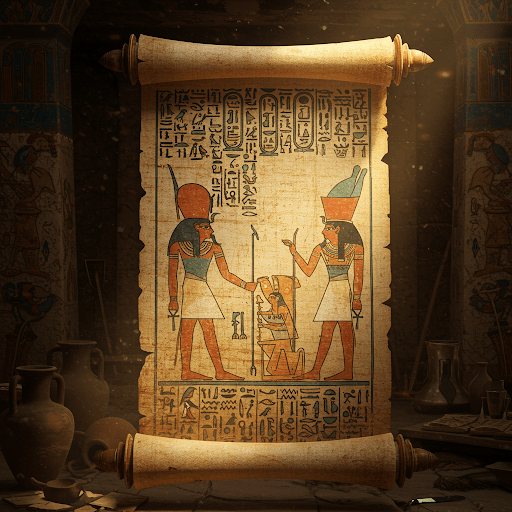
Have you ever heard of the Ipuwer Papyrus? It is an ancient document. The person writing it seems to have witnessed the 10 plagues that God brought against Egypt. I ran across this video on YouTube which does a good job of describing the document. There are so many archaeology finds that confirm the Bible. I just like to share them as faith builders. Here is a summary from the video.
Summary:
The video discusses the Ipuwer Papyrus, an ancient Egyptian document, and its potential connection to the biblical account of the Exodus. The speaker argues that the papyrus describes catastrophes that parallel the plagues of Egypt, providing archaeological evidence for the Exodus story.
Key Points:
- Ipuwer Papyrus: The Ipuwer Papyrus is presented as an ancient Egyptian document in the Leiden Museum, Netherlands, that describes catastrophes or plagues that befell Egypt.
- Similarities to Exodus: The speaker highlights ten specific parallels between the descriptions in the Ipuwer Papyrus and the plagues described in the Book of Exodus.
- Timeframe of the Exodus: The video references 1 Kings 6:1 to establish a timeframe for the Exodus around 1440 BC, based on the construction of Solomon’s Temple.
- 1 Kings 6:1 (ESV): “In the 480th year after the people of Israel came out of the land of Egypt, in the fourth year of Solomon’s reign over Israel, in the month of Ziv, which is the second month, he began to build the house of the Lord.”
- Dating the Papyrus: The speaker acknowledges that the exact date of the Ipuwer Papyrus is debated among scholars, with estimates ranging from 1550 BC to 1290 BC, but notes that some scholars date it close to the 1440 BC timeframe.
- Specific Parallels: The speaker presents the following parallels between the Ipuwer Papyrus and the Book of Exodus:
- Ipuwer: “There’s blood everywhere…Lo the river is blood.”
- Exodus 7:20-21 (ESV): “Moses and Aaron did as the Lord commanded. In the sight of Pharaoh and in the sight of his servants he lifted up his staff and struck the water in the Nile, and all the water in the Nile turned into blood. And the fish in the Nile died, and the Nile stank, so that the Egyptians could not drink the water of the Nile. There was blood throughout all the land of Egypt.”
- Ipuwer: “One thirsts for water.”
- Exodus 7:24 (ESV): “And all the Egyptians dug along the Nile for water to drink, for they could not drink the water of the Nile.”
- Ipuwer: “Lo, trees are felled, branches stripped.”
- Exodus 9:24 (ESV): “The hail struck down everything that was in the field in all the land of Egypt, both man and beast. The hail struck down every plant of the field and broke every tree of the field.”
- Ipuwer: “Lo, grain is lacking on all sides.”
- Exodus 9:31 (ESV): “The flax and the barley were struck down, for the barley was in ear and the flax was in bud.”
- Ipuwer: “Birds find neither fruit nor herbs.”
- Exodus 10:15 (ESV): “For they covered the whole face of the land, so that the land was darkened, and they ate all the plants in the land and all the fruit of the trees that the hail had left. Not a green thing remained, neither tree nor plant of the field throughout all the land of Egypt.”
- Ipuwer: “Groaning is throughout the land, mingled with laments.”
- Exodus 12:30 (ESV): “And Pharaoh rose up in the night, he and all his servants and all the Egyptians. And there was a great cry in Egypt, for there was not a house where there was not someone dead.”
- Ipuwer: “Lo, many dead are buried in the river, the stream is the grave, the tomb became a stream, and he who puts his brother in the ground is everywhere.”
- Numbers 33:4 (ESV): “For the Egyptians were burying all their firstborn, whom the Lord had struck down among them.”
- Ipuwer: “All is ruin!”
- Exodus 10:7 (ESV): “Then Pharaoh’s servants said to him, “How long shall this man be a snare to us? Let the men go, that they may serve the Lord their God. Do you not yet understand that Egypt is in ruin?””
- Ipuwer: “The land is without light.”
- Exodus 10:22-23 (ESV): “So Moses stretched out his hand toward heaven, and there was pitch darkness in all the land of Egypt for three days. They did not see one another, nor did anyone rise from his place for three days, but all the people of Israel had light where they lived.”
- Ipuwer: “Gold and lapis lazuli, silver and malachite, carnelian and bronze… are fastened on the neck of female slaves.”
- Exodus 12:35-36 (ESV): “The people of Israel had also done as Moses told them, for they had asked the Egyptians for silver and gold jewelry and for clothing. And the Lord had given the people favor in the sight of the Egyptians, so that they let them have what they asked. Thus they plundered the Egyptians.”
- Ipuwer: “There’s blood everywhere…Lo the river is blood.”
- Attack on Egyptian Gods: The speaker points out that the plagues described in Exodus were also attacks on the major gods of Egypt.
- Significance: The speaker concludes that the Ipuwer Papyrus provides evidence supporting the biblical account of the Exodus, which he sees as further proof of the Bible’s truth and reliability.
 Biblical Logos Blog
Leave a comment