
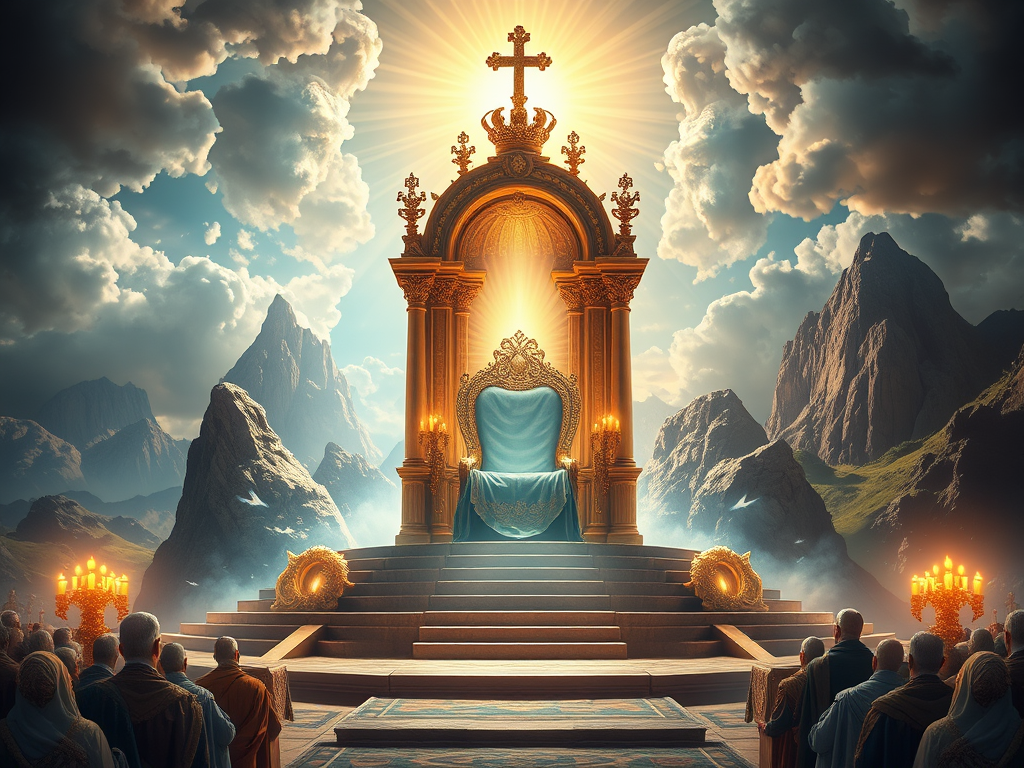
The longer I study the Bible, the more I’m convinced that understanding “The Kingdom” referenced throughout the Bible is second only in importance to understanding the Gospel.
What is The Kingdom?
This is where it all starts. In the New Testament, the Kingdom is referenced often. Familiar passages like “Luke 17:20-21: “Nor will they say, ‘Look, here it is!’ or ‘There it is!’ For behold, the kingdom of God is in the midst of you.” Some translations even say “the kingdom of God is within you. (KJV).” The common belief this leads to is thinking “The Kingdom” is a spiritual thing that manifests within Christians as we come to believe the Gospel. Is that it? Doesn’t Jesus say “Luke 16:16: “The Law and the Prophets were until John; since then the good news of the kingdom of God is preached, and everyone forces his way into it.” So The Kingdom comes through the Church?
That understanding misses the entire picture. The Old Testament is filled with the promises of “The Kingdom” it is actually where the notion of a coming Kingdom is defined. Lets look at just a few examples:
2 Samuel 7:12-16 (ESV)
12 When your days are fulfilled and you lie down with your fathers, I will raise up your offspring after you, who shall come from your body, and I will establish his kingdom. 13 He shall build a house for my name, and I will establish the throne of his kingdom forever. 14 I will be to him a father, and he shall be to me a son. When he commits iniquity, I will discipline him with the rod of men, with the stripes of the sons of men, 15 but my steadfast love will not depart from him, as I took it from Saul, whom I put away from before you. 16 And your house and your kingdom shall be made sure forever before me.[a] Your throne shall be established forever.’”
Psalm 2:6-8: “As for me, I have set my King on Zion, my holy hill… I will make the nations your heritage, and the ends of the earth your possession.” This psalm speaks of God’s appointed King reigning over all nations.
Isaiah 9:6-7: “For to us a child is born, to us a son is given; and the government shall be upon his shoulder… Of the increase of his government and of peace there will be no end, on the throne of David and over his kingdom, to establish it and to uphold it with justice and with righteousness from this time forth and forevermore.” This is a clear prophecy of the coming Messianic King and His eternal kingdom.
Jeremiah 23:5: “Behold, the days are coming, declares the LORD, when I will raise up for David a righteous Branch, and he shall reign as king and deal wisely, and shall execute justice and righteousness in the land.”
Although this is just a small sampling of what the Old Testament has to say about The Kingdom, I believe it is easy to see that the Old Testament promises (to the Jewish people in particular), sees an eternal Earthly Kingdom in the future. This Kingdom is established through the covenant (unconditional) made to King David (not the Church). That it will be ruled by Jesus.
The Jewish people were eagerly awaiting this promise of God. Even to the point of after Jesus death and resurrection, the Apostles asked Jesus about The Kingdom “Acts 1:6 So when they had come together, they asked him, “Lord, will you at this time restore the kingdom to Israel?”. Notice that even the Apostles who walked with Jesus and preached with him believed the covenant to the Jewish people of the Kingdom was yet to come!
The Error Over Time
Many current movements within Christianity take a perverted understanding of “The Kingdom” in the Bible as the basis to create whole new theologies and sects which start acting on non-Biblical beliefs. Some examples include Kingdom Now or Dominion theology, the New Apostolic Reformation crowd and the Seven Mountain Mandate believers. If this terminology or these groups are unfamiliar for you, some of the basic tenants of these beliefs include believing Christians have a biblical mandate to bring in the Kingdom of God. In these groups, the Kingdom gets brought in through Christians taking control of society and conquering the Earth before the return of Jesus.
As the Bible says, “…nothing is new under the sun. (Ecclesiastes 1:9)”. Historically, much of Christianity has tripped up over understanding “The Kingdom”. Replacement theology/Supersessionism (believing the promises made to the Jewish people in the Old Testament, now are given to the Church), is the same error, just in a different form. Large denominations have believed this going all the way back to the Early Church. Catholics, Eastern Orthodox Churches and several prominent protestants denominations like the Lutheran church, Reformed Churches (Presbyterian, Congregational), Methodist Churches and Anglican Communion/Episcopal Churches. These very large groups of Christians have a general notion which says “God has punished and rejected the Jewish people for their rejection of Jesus, leading to the Church replacing them.” The Kingdom promises from the Old Testament now apply to the Church. More directly, most all of these same groups also hold to a view called Amillennialism. Amillennialism is a belief that there is no 1,000 year reign of Christ on the throne in Israel, but that some day there will be a second coming and then eternity. It is just another error of not understanding The Kingdom and the fulfillment of the Old Testament.
The Correction from Paul
The whole Book of Romans lays out the core Christian doctrines that God is delivering to the Church through Paul. In Romans 9:1 – 11:36, he is specifically defining how God has, and will use the Jewish people and Gentile people to bring in his plans. In Romans (10:1-21): Paul clarifies that Israel’s rejection of Christ was due to their pursuit of righteousness through law instead of faith. He emphasizes that salvation is available to all who call on the name of the Lord, Jews and Gentiles alike. In Romans (11:1-36): Paul affirms that God has not completely rejected Israel. Their hardening is partial and temporary, allowing for the inclusion of Gentiles. He uses the analogy of an olive tree, where some natural branches (Israel) were broken off, and wild branches (Gentiles) were grafted in. He warns Gentiles against arrogance and proclaims that “all Israel will be saved” in God’s eschatological plan.
It is hard to believe that entire denominations went down this path. How could they miss passages like “Rom 11:1-2: I ask, then, has God rejected his people? By no means! For I myself am an Israelite, a descendant of Abraham, a member of the tribe of Benjamin. God has not rejected his people whom he foreknew…”.
Matthews Gospel in particular has a theme of The Kingdom. In Matthew 13, Jesus gives several parables of what the Kingdom will be like. In several other passages, you can see Jesus focus on explaining The Kingdom:
Matthew 5:3 (Beatitudes): “Blessed are the poor in spirit, for theirs is the kingdom of heaven.”
Matthew 7:21: “Not everyone who says to me, ‘Lord, Lord,’ will enter the kingdom of heaven, but the one who does the will of my Father who is in heaven.”
Mark 10:14-15 (and Matthew 19:14; Luke 18:16-17): “Let the little children come to me; do not hinder them, for to such belongs the kingdom of God. Truly, I say to you, whoever does not receive the kingdom of God like a child will not enter it.”
Matthew 18:3: “Truly, I say to you, unless you turn and become like children, you will never enter the kingdom of heaven.”
So it is important to understand that Matthew in particular was recording a gospel for the Jewish people. Dallas Theological Seminary Professor Stan Toussaint teaches a deep lesson on The Kingdom which is very well worth studying. He describes the context of The Kingdom being defined by the Old Testament. That is represents a yet future event where Jesus is on the throne in Israel forever. That the New Testament references to The Kingdom is not a spiritual promise to the believing Church, but a fulfillment of the Old Testament promises including the promise to King David and the Davidic Covenant.
Conclusion
The Church needs to really understand the meaning of “The Kingdom” in the context to the whole Bible. Taking a few passages out of context has led to some of the biggest errors and divisions within the Church and some really damaging theology. Dr. Andy Woods has written a compelling book on this topic which I highly recommend.
 Biblical Logos Blog
Leave a comment