
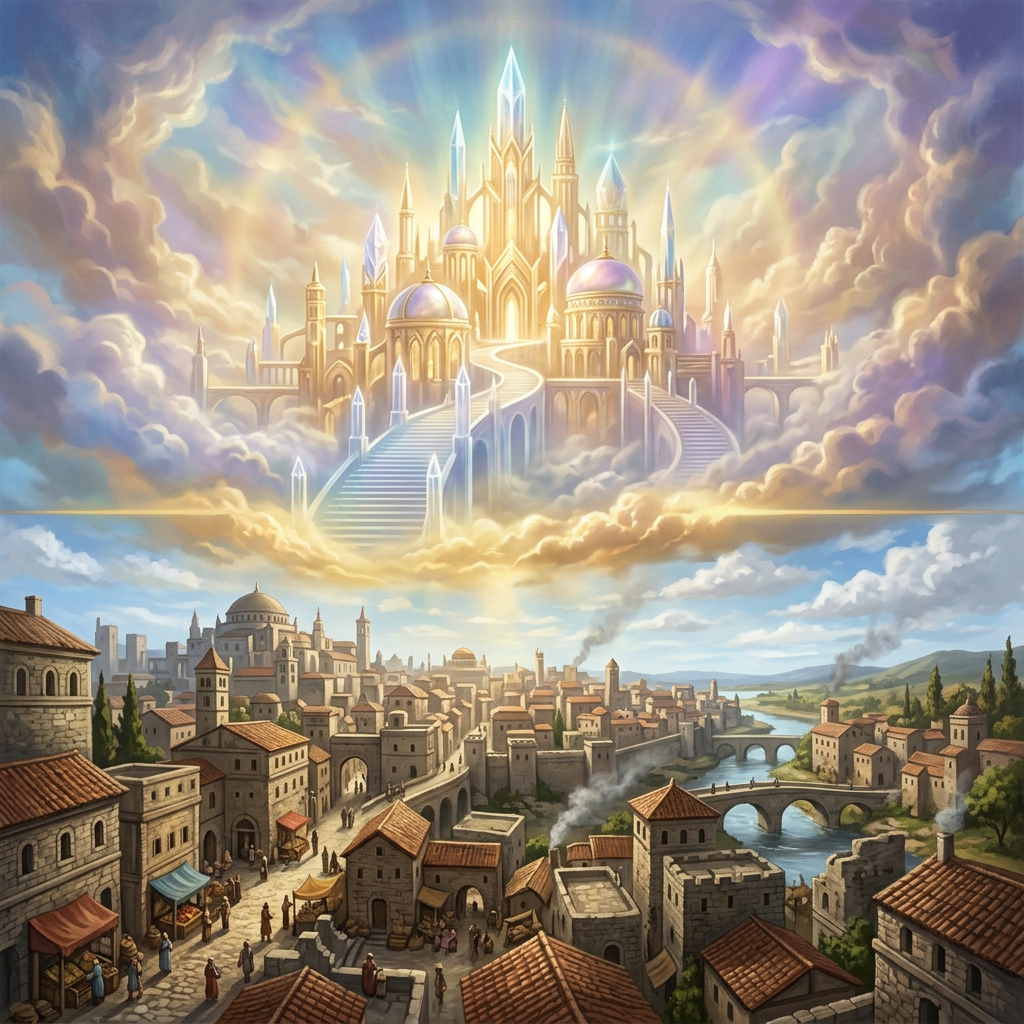
One of the most persistent questions in biblical prophecy is how to reconcile the detailed, ritualistic instructions for the Millennial Temple in Ezekiel 40–44 with the perfected, holy vision of the New Jerusalem in Revelation 21–22.
Many scholars struggle to harmonize the two, but the solution may lie in a dual-structure reality: the coexistence of both cities during the thousand-year reign of Christ. By viewing these not as sequential events, but as a simultaneous administration, we see a clear division between Earthly Instruction and Celestial Rule.
A Tale of Two Cities
The following table outlines the structural and administrative differences between the two entities as they operate during the Millennium.
| Feature | Earthly Millennial Jerusalem | New Jerusalem (The Church/Overcomers) |
| Primary Status | Earthly (Site of Temple) (Ezekiel 40-42) | Descending/Coexisting (Revelation 21:2) |
| Sacrificial System | Present/Memorial (Ezekiel 43:19, 25) | Absent (Revelation 21:27) |
| Governing Authority | The Prince/Davidic Lineage (Ezekiel 44:3) | Church/Overcomers (Rev 2:26-27, 3:21) |
| ‘Holy of Holies’ | Present in Temple (Ezekiel 41:4) | The entire city (Revelation 21:22) |
| Governing Symbolism | Divine Order for Earth (Isaiah 2:3) | 12,000 Stadia (Rev 21:16) |
| Primary Purpose | Instruction/Center of Worship (Isaiah 2:3) | Rule and Reign with Jesus (Rev 20:4) |
The Administrative Model
In this view, the Millennium operates through a two-fold administration:
- The Earthly Jerusalem as the Terrestrial Focal Point: This city serves as the historical fulfillment of the Davidic covenant. With its physical temple and sacrificial system, it acts as a “classroom” for the nations, where the law of the Lord is taught and the glory of God is tangibly centered on earth.
- The New Jerusalem as the Celestial Seat: This city is the home of the “Overcomers”—the Church—who are promised to rule and reign with Christ. Its dimensions (12,000 stadia) symbolize the perfection of divine government. This is the “place” Jesus prepared (John 14:2–3) for those who persevered, descending as a distinct, holy sphere from which the kingdom is governed.
Why This Matters
This model elegantly resolves the tension between the “ritual” nature of Ezekiel’s prophecy and the “perfected” nature of John’s vision. While the Earthly Jerusalem continues the work of restorative worship, the New Jerusalem stands as the seat of the redeemed, reflecting the complete holiness of the Lamb.
The Bible is filled with these subtle, symbolic clues. By recognizing that the New Jerusalem is not just a destination for eternity, but the governing center for the Millennial reign, we gain a deeper appreciation for the structured, sovereign order that Christ will establish when He returns.
To explore more on this topic, check out my previous analysis: Revelation 21 and 22 in the Millennium.


Leave a Reply