
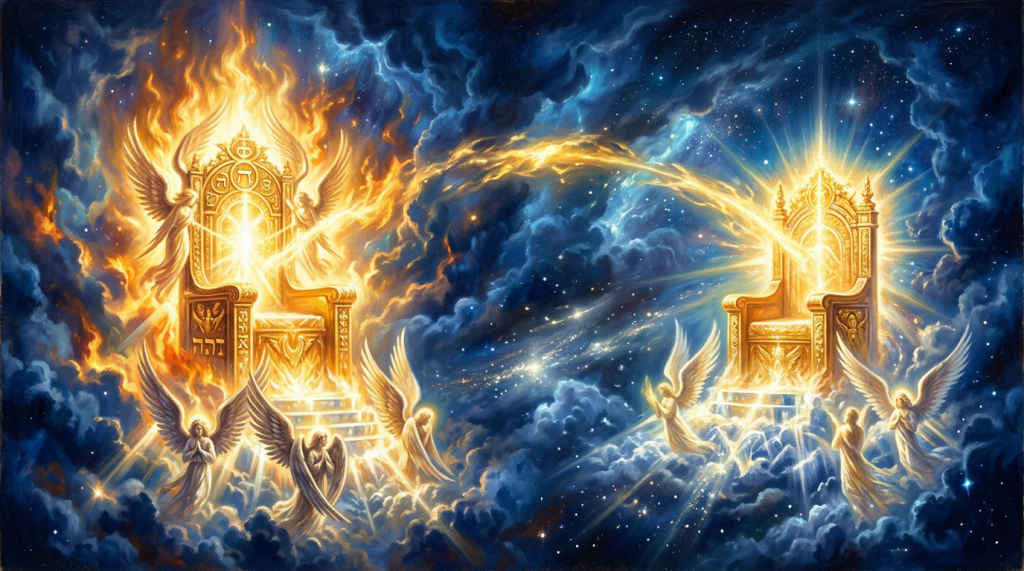
When we study the Old Testament through a literal and historical lens, we often uncover foundational patterns that prepare the way for the New Testament. One of the most compelling examples occurs when Jesus challenged the religious leaders of His day using King David’s words in Psalm 110:1:
“The LORD says to my Lord: ‘Sit at my right hand, until I make your enemies your footstool.’”
Jesus pointed out a profound truth hidden in the Hebrew text. If the Messiah were merely a human descendant of David, why would David address Him as “my Lord”? In the original language, David distinguishes between two figures: Yahweh (the covenant name of God the Father) speaking directly to Adoni (David’s Sovereign Lord, the Messiah).
While Psalm 110:1 is the most well-known passage highlighting this dynamic, it is not an isolated occurrence. Throughout the Hebrew Scriptures, we find multiple passages where two distinct divine figures—often both identified as Yahweh or God—interact in ways that reveal the relationship between God the Father and God the Son.
Here are six key Old Testament passages that share this remarkable pattern.
1. Yahweh on Earth and Yahweh in Heaven (Genesis 19:24)
“Then the LORD rained on Sodom and Gomorrah sulfur and fire from the LORD out of heaven.”
In Genesis 18 and 19, the LORD (Yahweh) appears in physical, human form to Abraham, shares a meal with him, and reveals the coming judgment on Sodom. When that judgment finally arrives in Genesis 19:24, the text makes a deliberate distinction: the Yahweh who had been walking and speaking on earth rains down fire from Yahweh out of heaven. This passage shows the visible, pre-incarnate Son executing the judgment of the invisible Father.
2. God Anointing God (Psalm 45:6–7)
“Your throne, O God, is forever and ever. The scepter of your kingdom is a scepter of uprightness; you have loved righteousness and hated wickedness. Therefore God, your God, has anointed you with the oil of gladness beyond your companions.”
In this messianic psalm, the writer addresses the eternal King directly as “God” (Elohim), yet in the very next sentence states that “your God” has anointed Him. The New Testament removes any ambiguity about who is speaking to whom. In Hebrews 1:8–9, the author quotes this exact passage and attributes it to God the Father addressing God the Son.
3. The Ancient of Days and the Son of Man (Daniel 7:13–14)
“I saw in the night visions, and behold, with the clouds of heaven there came one like a son of man, and he came to the Ancient of Days and was presented before him. And to him was given dominion and glory and a kingdom, that all peoples, nations, and languages should serve him…”
Daniel’s vision presents two distinct figures in the heavenly court. First is the “Ancient of Days”—God the Father seated upon His throne. Approaching Him on the clouds of heaven (an attribute reserved strictly for deity in the Old Testament) is “one like a son of man,” who is given eternal dominion and worship. Jesus adopted “Son of Man” as His primary title for Himself and cited this exact prophecy during His trial before the Sanhedrin in Mark 14:62.
4. The LORD Sent by the LORD (Zechariah 2:8–11)
“For thus said the LORD of hosts, after his glory sent me to the nations who plundered you… ‘Behold, I will shake my hand over them, and they shall become plunder for those who served them. Then you will know that the LORD of hosts has sent me.’”
Notice the speaker in this prophetic oracle. The one speaking is explicitly identified as the “LORD of hosts” (Yahweh). Yet, He repeatedly declares that the “LORD of hosts” has sent Him to dwell in the midst of His people. Here we see a clear distinction between Yahweh the Sender and Yahweh the Sent—a direct Old Testament parallel to Jesus’s frequent teaching in the Gospels that the Father sent Him into the world.
5. The Creator and His Son (Proverbs 30:4)
“Who has ascended to heaven and come down? Who has gathered the wind in his fists? Who has wrapped up the waters in a garment? Who has established all the ends of the earth? What is his name, and what is his son’s name? Surely you know!”
Through a series of rhetorical questions pointing to the omnipotence of the Creator, Agur asks who holds sovereign control over creation. While the answer is unmistakably God, the writer presses further, asking not only for the Creator’s name, but also for His son’s name. Long before the incarnation, wisdom literature pointed toward the eternal Father-Son relationship within the Godhead.
6. Saved by the LORD, Through the LORD (Hosea 1:7)
“But I will have mercy on the house of Judah, and I will save them by the LORD their God. I will not save them by bow or by sword or by war or by horses or by horsemen.”
In this verse, God (Yahweh) is speaking in the first person, promising to deliver Judah not through human military strength, but by divine intervention. Rather than saying, “I will save them by My own hand,” He declares, “I will save them by the LORD [Yahweh] their God.” Just as in Genesis 19:24, the text distinguishes between the God who initiates salvation and the divine Lord through whom that salvation is accomplished.
Unfolding the Pattern of Scripture
When we compare Scripture with Scripture, it becomes clear that the New Testament revelation of the Father and the Son is deeply rooted in the Old Testament. From the historical narrative of Genesis to the wisdom of Proverbs and the visions of the Prophets, the Hebrew text consistently reveals a unified Godhead in which the Father sends, anoints, and decrees, while the Son carries out creation, judgment, and redemption.


Leave a Reply