
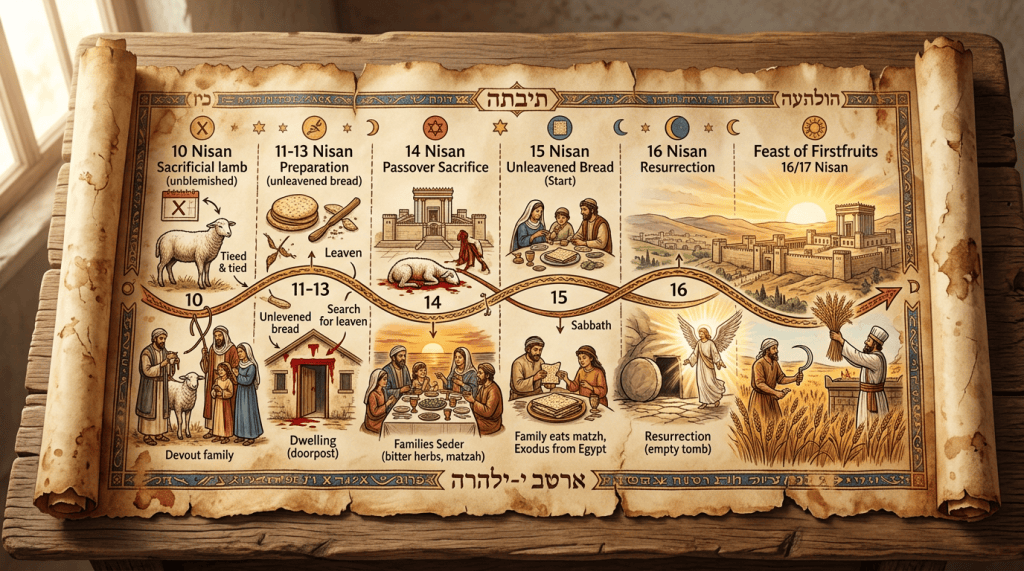
When we read the instructions given in the Torah regarding Passover—found across Exodus 12, Leviticus 23, and Deuteronomy 16—we often view them strictly as historical memorials of Israel’s deliverance from Egypt. However, when laid side-by-side with the final week of Jesus’ life in the Gospels, these feasts reveal an astonishing, precision-engineered prophetic timeline.
Every detail, down to the exact day, points directly to the ultimate sacrifice and triumph of Christ. Below is a day-by-day comparative table tracing the steps of the Passover from the Torah alongside the events of Passion Week, highlighting a Wednesday crucifixion, the three days and nights of the Feast of Unleavened Bread, and the resurrection on the Feast of First Fruits.
Passover in the Torah vs. Gospel Fulfillment Table
| Day / Date (Nissan) | Passover & Torah Instructions (Exodus, Leviticus, Deuteronomy) | Gospel Events & Fulfillment (New Testament) | Key Bible Verses |
| Nissan 10 (Sunday) | Selection of the Lamb: Each household is commanded to select an unblemished, year-old male lamb on the tenth day of the first month. | The Triumphal Entry: Jesus enters Jerusalem riding on a colt, presenting Himself publicly to the nation as Israel’s long-awaited King and the ultimate Lamb of God. | Exodus 12:3, 5; Deuteronomy 16:1–2; Matthew 21:1–11; Mark 11:1–11; Luke 19:28–44; John 12:12–15 |
| Nissan 11–13 (Monday – Wednesday Daytime) | The Inspection Period: The selected lamb is kept and closely watched for four days (from the 10th to the 14th) to ensure it is entirely without spot or blemish. | Public Examination: Jesus teaches daily in the temple courts, undergoing intense questioning, scrutiny, and cross-examination by the Pharisees, Sadducees, and scribes. Ultimately, even His judges declare, “I find no fault in Him”. | Exodus 12:6; Matthew 21:23–23:39; Luke 20:1–47; John 12:36–50 |
| Nissan 14 (Wednesday Afternoon) | Slaughter of the Lamb: The Passover lamb is to be killed by the whole assembly of Israel “at twilight” (between the evenings) on the 14th day, and its blood applied. | The Crucifixion: Jesus is crucified on the cross. He yields up His spirit precisely at the ninth hour (3:00 PM)—the exact time the Passover lambs were being slaughtered by the priests in the temple. | Exodus 12:6; Leviticus 23:5; Deuteronomy 16:5–6; Matthew 27:32–56; Luke 23:26–49; John 19:16–30 |
| Nissan 15 – 17 (Wednesday Sundown – Saturday Sundown) | Feast of Unleavened Bread: The 15th marks a high Sabbath (holy convocation) where no regular work is done, initiating the 7-day removal of leaven. | Three Days and Three Nights: Jesus rests in the tomb. This period fulfills the “sign of Jonah” (three days and three nights in the heart of the earth), spanning across the high Sabbath and the weekly Sabbath. | Exodus 12:15–18; Leviticus 23:6–8; Matthew 12:40; Matthew 27:62–66; Luke 23:54–56 |
| Nissan 17 (Sunday Morning) | Feast of First Fruits: The priest waves the first sheaf of the barley harvest before the Lord “on the morrow after the Sabbath”. | The Resurrection: Jesus rises victoriously from the dead early on Sunday morning, becoming the spiritual “firstfruits of those who have fallen asleep,” exactly as the Apostle Paul explains. | Leviticus 23:10–11; Matthew 28:1–10; 1 Corinthians 15:20 |
Key Insights from the Timeline
1. The 10th of Nisan and the Public Inspection
In Exodus 12, God commanded that the Passover lamb be brought into the home on the 10th of Nissan. This gave the household four full days to inspect the animal, ensuring it met every requirement of perfection. When Jesus rode into Jerusalem on a colt on that exact day (traditionally remembered as Palm Sunday), He entered the public eye for intense scrutiny. For the next three days, religious leaders tested Him with trick questions, yet He remained entirely spotless, flawless, and without sin.
2. The Wednesday Crucifixion and the Sign of Jonah
A common point of confusion in traditional calendars is fitting “three days and three nights” into a Friday-to-Sunday window. However, when we look at the biblical text, John notes that the Sabbath following the crucifixion was a “high day” (the 15th of Nisan, the first day of Unleavened Bread), distinct from the weekly Saturday Sabbath.
By placing the crucifixion on Wednesday afternoon (Nissan 14):
- Jesus is buried before sunset on Wednesday evening.
- He spends Thursday (Day 1 / High Sabbath), Friday (Day 2 / preparation and spice-buying day between Sabbaths), and Saturday (Day 3 / weekly Sabbath) in the tomb.
- This accounts for precisely three days and three nights in the heart of the earth, fulfilling Jesus’ own prophecy of the sign of Jonah.
3. Fulfilled in the Feast of First Fruits
The timeline culminates precisely on the Feast of First Fruits (Nissan 17). According to Leviticus 23, the Israelites were commanded to bring the very first sheaf of the spring harvest to the priest to be waved before God. Writing to the Corinthians centuries later, Paul draws heavily on this imagery, declaring:
“But now Christ is risen from the dead, and has become the firstfruits of those who have fallen asleep.” — 1 Corinthians 15:20
Jesus didn’t just fulfill Passover metaphorically; He fulfilled it chronologically, down to the exact calendar appointments (Moedim) established by God at Sinai.


Leave a Reply